
Kur’an-ı Kerim’de Aşk-Love in the Holy Qur’an

İslam hakkındaki yaygın yanlış kanılardan biri, onun bir sevgi dini olmadığıdır. Bu yanlış anlaşılmanın birkaç nedeni vardır – bunların arasında tarihsel kökenindeki çekişme, içsel ruh pahasına dışsal toplumsal reçetelere odaklanma, kutsal İslam Peygamberinin tasvir edilmesine ilişkin bazı tarihsel önyargılar (onu Tanrı’nın şefkatli bir elçisi olmaktan çok, Hristiyanlıkla polemik bir tezat teşkil edercesine ‘cihatçı’ olarak nitelenmesi. Cihatçı terimi elbette burada aşağılayıcı anlamda kullanılmaktadır. (örneğin, Papa XVI.Benedict’in 2006’da Regensburg konferansında).
Bir anlamda, İslam’ın her şeyden önce bir bilgi dini olarak görüldüğü takdirde Hıristiyanlığın,, üstün bir sevgi dini olduğu şüphesiz doğrudur. Ancak bu genellemeler, ilahi gerçekliğin (Bir olan) ve vahiylerinin (çok sayıda) altında yatan metafizik nüansı görmezden gelir: her otantik inanç geleneği, benzersizliğine rağmen, evrensel anlamda Hakikate hitap eder ve insan katılımını talep eden bir şekilde (dışa veya içe doğru eylemsel ve düşünsel, kalbi, ruhu, zihni ve duyuları hesaba katarak) hakikate çağırır. Bu çağrı bireysel insan yetilerimizin tamlığını ve farklı ilişkilerimizin çeşitli yönlerini dikkate alarak katılımımızı talep eder. (Yaratıcımıza ibadet yoluyla ve yaratılışta kardeş olduğumuz diğer insanlara karşı etik davranış yoluyla). Dinin belirli bir yönü belirli bir yatkınlığa hitap edebilirken, her din, manevi kapasitelerimizi devreye sokmak ve sonunda ruhlarımıza ilham vermek için farklı bir kapsam içerir. Tüm yaratıkların aşkın doğaları aracılığıyla temelde yatan uyumunun evrensel bir doktrinini paylaşmayan otantik bir inanç geleneği veya bu uyumu manevi birlik yoluyla gerçekleştirmenin evrensel bir metodolojisi yoktur. Sonuç olarak, onu ideolojik veya antropolojik olarak gören, özellikle sevgi ve şefkatin temel metafizik boyutlarından kopuk, indirgemeci bir İslam görüşü, onun maneviyatını temelden yanlış anlamak olacaktır.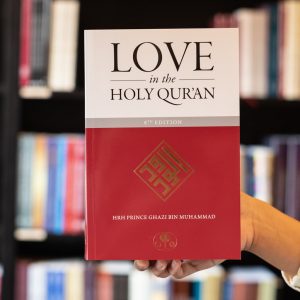
Love in the Holy Qur’an
One of the common misconceptions about Islam is that it is not a religion of love. There are several reasons for this misconception— among them, the strife in its historical origins, the focus on its outward social prescriptions at the apparent expense of its inner spirit, certain historical inaccuracies regarding the portrayal by the holy Prophet of Islam (casting him as a ‘jihad- ist’, in the derogatory sense of that term, rather than as a compassionate messenger of God), and a polemical contrast with Christianity (evident, for example, in Pope Benedict XVI’s Regensburg lecture in 2006).
In a certain sense, it is no doubt true—a truth that is generally acknowledged by Muslims—that Christianity is pre-eminently a religion of love in a way that Islam might be regarded as pre-eminently a religion of knowledge. But these generalizations ignore the metaphysical nuance that underlies divine reality (which is One) and its revelations (which are many): each authentic faith tradition, notwithstanding its uniqueness, addresses Truth in a universal sense, summoning forth human engagement in a way that demands our participation in the fullness of our individual human faculties (outwardly and inwardly, actively and contemplatively, engaging the heart, soul, mind, and senses) and in the diversity of our manifold relationships (through the worship of our Creator, and through ethical behavior towards our fellow creation). While a particular aspect of religion may appeal to a particular predisposition, each religion contains a diverse scope to engage our spiritual capacities and, in the end, to inspire our souls. There is no authentic faith tradition that does not share a universal doctrine of the underlying harmony of all creatures through their transcendent nature, or a universal methodology of actualizing that harmony through the spiritual union. As a result, a reductive view of Islam that would view it ideologically or anthropologically, disconnected from certain of its modes, in particular from the core metaphysical dimensions of love and compassion, would be to fundamentally misunderstand its spirituality.
There is a great need in our times when Islam is so radically misunderstood and misportrayed by non-Muslims and Muslims alike, to educate people about its essential truths, to demonstrate the compassionate and universal heart of its message, to explain its affinity to other faith traditions and its relevance to our individual lives. Prince Ghazi, the author of this book, has been engaged in precisely this type of endeavor in his several educational and interfaith projects, among them his authoring of the historical Open Letter “A Common Word Between Us and You” in 2007. His book, Love in the Holy Qur’an, identifies several goals including “to show that, contrary to non-Muslim perceptions, not only does the Qur’an treat of love repeatedly and extensively but also all that one may know about love is explained in the Book of God—the Holy Qur’an.”
The book is a translation by Khalid Williams from the Arabic of Prince Ghazi’s 2010 thesis for his second Ph.D. from Al-Azhar University in Cairo (his first Ph.D. was from Cambridge). The Arabic edition has been widely acclaimed, and this English edition is graced with a Foreword by the distinguished Professor Seyyed Hossein Nasr who emphasizes the metaphysical centrality of “love”, its divine origin, its cordial and theophanic presence, its scriptural and ritual importance, its association with the Prophetic Norm, and the correspondences and reflections of the Divine Names and Qualities within nature and in ourselves and in the scope of the human experiences of love. All these themes are expounded upon wonderfully by Prince Ghazi within this fine book.
Throughout the text, Prince Ghazi is careful in his methodology to strictly support all his statements on the subject of love by reference to the Holy Qur’an itself, delving into its principal foundations, but supporting his reading of the scripture from hadiths and commentaries only collaboratively where appropriate. Special attention is paid to the sacred etymology of the Qur’anic language to explain its linguistic richness—a feature that is particularly valuable to non-Arabic-speaking readers. In one chapter, for example, the author enumerates with detailed commentary the thirty-seven different kinds of love mentioned in the Holy Qur’an, providing lexical definitions and teasing out the nuances of each description, and in another chapter, he provides the Qur’anic descriptions of the twelve kinds of people whose qualities are not loved by God.
Proceeding from a definition of love that links it to beauty, the book elaborates on the distinction between Divine love—as a free gift emanat- ing from Divine Nature and as Beauty itself—and human love—as “an inclination to beauty after being pleased by it.” The author elaborates on the Divine Nature which in its quintessence combines the Qualities of Love and Mercy. These are the source and motive for creation, are present in God’s love for creation—pre-eminently His messengers and Prophets, and within souls that are beautiful and virtuous according to their measure—and are reflected in varying degrees within the created universe.
In a section of the book which deals with the Holy Prophet of Islam, the author describes the reciprocal love of God and His beloved Messenger, and how the Messenger’s heart was infused with the Qualities of Love and Mercy. This section may have benefited from further elaboration on the correspondence between the Holy Prophet’s radiant Nature and the Divine Nature, reflected in the Prophetic Qualities that correspond to the Norm to be emulated by human beings. As each theology articulates in its own way the universal and perennial Truth of its Message, so each Messenger reflects the reality of the Divine Nature uniquely. Christian readers of this work will undoubtedly be inclined to contrast the scriptural references to Holy Prophet of Islam with those of the Holy Prophet of Christianity, and maybe struck by the different ways in which they reflect, through loving-compassion, a similar quality—their self-effacing humanity in the face of Divine Love.
The author then treats in some detail the subject of human love—for God, for His Messenger and kinfolk, for family, for humanity, and for one’s spouse and through romantic and physical love. It is evident that the Holy Qur’an addresses these issues, often at length and with nuance (there are at least thirty-seven different kinds of love described), and in ways that resonate with other literature about the different types of love—for example, Greek conceptions of love as agape, philia, and eros, or later treatments of it by European writers such as Dante and C.S. Lewis.The Qur’anic references to the power of the human face and eyes to convey love are a reminder of the metaphysical concept of “The Meeting of Eyes” (about which, for example, Ananda Coomaraswamy has written) and also of the Muslim influence within the Courtly Love traditions.
At the beginning of the welcome and scholarly book, Prince Ghazi exhorts the reader to approach the book not merely at arms’ length as a harmonious philosophical theory, but to engage with it contemplatively and experientially. This advice is particularly important with regard to a section of the book which is devoted to outlining the stages of love. The author has identified no less than one hundred stages of human love that are mentioned in the Holy Qur’an, which are then related by the author to the engagement of the human faculties of the physical body, the psychic soul, and the transcendent spirit, in the process of the initiation and growth of love. Throughout, the reader is reminded how all human love is a mode of inclining towards beauty after having been pleased by it, and is related to the Divine Nature to which the human Norm corresponds. The chapters in which the author describes the two circles of love (of licit love, prompted by faith; and of illicit love, prompted by disbelief) and the triangle of love (in which the lover’s love for the beloved is prompted by the lover’s image or ‘adornment’ of the beloved) have much food for reflection for those interested in the sacred science of spiritual psychology, demonstrating how licit love is wedded to Virtue itself, which is intrinsic Beauty. And in a profound final section, the author relates Love to Beatitude, to an extinctive plenitude in which the soul is perfected and renewed in Beauty, in the true intended object of Love—who is God Alone.
We know of no similar work in the English language. Prince Ghazi’s scholarly book will become an authoritative text on the subject and is an invaluable resource that thoroughly refutes the misconceived view that Islam is not a religion of love. We recommend it to all readers, and especially to non-Muslim theologians who are interested in knowing
By HRH Prince Ghazi bin Muhammad bin Talal
Foreword by Seyyed Hossein Nasr
Kazi Publications, Chicago, 2010
Reviewed by M. Ali Lakhani
About The Author